Wednesday, February 23, 2011

STRUGGLES ALONG THE WAY -- Kristi

The reality of having a new baby was probably both the best and worst thing Bill and I could have done at the time. I am convinced it saved our marriage, but it also almost cost us it more than once. On the upside, Bill becoming a father completely transformed him from a cute, funny, happy-go-lucky, but sometimes irresponsible guy, to a full grown adult and partner in our marriage – while still being cute and funny! He is and has been a great step dad to my older girls, and an amazing father to Jannie.

On the downside, Rose was seven-years old when Jannie was born, and had become pretty self sufficient in her daily life. She could set her own alarm clock, get up for school, make her own breakfast and lunch, while I would stagger out to get a cup of coffee and head back to bed for a moment or two. Life was getting good!

Seven years is a long time between children, and the mind has a way of forgetting what it doesn’t want to remember. The new demand of diapers, feedings, and never enough sleep was a hard smack-back for me. On top of that, I was the primary wage earner for our family at the time, and had to go back to work when Jannie was a month old.

Trying to nurse while I was traveling for work was exhausting, and Jannie was not a great sleeper. She took a few naps but did not sleep much at night. Consequently, neither did we. This was less of a problem for Bill as he doesn’t need much sleep, but I am a nine-hour-a-night-gal. To make matters worse, our tiny cabin was so small we literally had no place to put our new kid. For the first year of her life (until we finally were able to get a new home) Jannie slept in a crib two inches from my head – or, should I say, she screamed two inches from my head. I was a zombie.

Once, when Jannie was three months old, I announced to my family that I needed a break. I made a reservation at the local four-star lodge where they offer cheap accommodations to locals during the off season. Leslye thought it was great! “Oh, it will be so fun! I’ll bring a bottle of wine and we can talk all night!” I think she was a little surprised when I said I was going to the lodge to sleep. But that’s what I did. I took a long bubble bath in the big hot tub with a wonderful view of the mountains. And then I slept for 15 hours straight. I had such a good time I went back the next week and did it all over again. To this day, it was the best money I’ve ever spent.

Fortunately for us, Jannie has grown to be a happy, sunny child who is self entertaining and loves the outdoors. She is remarkably like her dad in both temperament and looks, but with a flare for the dramatic and a penchant to talk too much that can only come from me. Sometimes the karma is just right.

So three years after coming to the valley, just as things were finally settling in, we threw this little monkey wrench into our lives just to make it interesting. And, it certainly did. For one thing, making a living all of a sudden got hard again, as one of us needed to stay home. Neither made enough money to justify infant day care costs, and we didn’t want to go that route anyhow. My job paid the most at the time, so I worked on outside consulting projects while Bill became a stay-at-home dad.

Working outside the valley was something that has served me well. People who work here often try to avoid controversy as it can cost them customers, money and maybe even their jobs. If you say or do something someone doesn’t like, they might stop shopping in your store or hiring you for work. Instinctively, after I arrived, I knew making my money outside the valley would allow me to maintain a voice on issues important to me. But that has occasionally meant I’m the only voice willing to speak up.

Asking why the school board ignored half a dozen letters from parents complaining about the high-school principal’s mistreatment of their kids, or why there were three free ski trails for people and their dogs, but no free ski trails for people and their kids, were questions that did not make me very popular in some circles. But I thought they needed to be asked. And as a consequence, I’ve developed a reputation as being either a troublemaker or “the conscience of the valley” depending on who you talk to. It makes for interesting contrast.

In a single day, for example, I might go to the grocery store and experience the “Valley Shun” where people refuse to look at you as they walk past. And then go to the gas station where someone hails me as their new hero. With my broadcasting background and fairly thick skin, I knew I had the skills for this job. But did I necessarily want it? Temperamentally, I had a hard time ignoring a problem that I thought I could resolve. But the cost was wearing me down.

Learning how to pick and chose my battles has been a learning curve. And then there was the issue of my “tone” or how I presented problems to people and to the press. “You sound so angry,” one woman complained, after I wrote a long editorial for the local paper on the documented abuses of our then high school Principal. “Well, yes, when adults with authority over children abuse them, it makes me a little pissed off. Go figure.”

On more than one occasion, I thanked my lucky stars for Bill, whose winning sense of humor could keep things light. Once, in the middle of a hard struggle with our local school district, Bill went to a school board meeting to present them with an award. After a little fanfare, he unwrapped a small statue of the three monkeys: See No Evil, Hear No Evil, Speak No Evil, much to the delight of the people present, and consternation of the board. That Bill was later elected as a member of our local school board was also a matter of consternation to them. But now most of these board members are gone and Bill is still there. We did a few things right.

This sort of struggle happens in small towns, where relatively small issues become huge, and everyone has an opinion about them. I don’t know what to say about that other than be who you are, while also thinking hard about whom you want to be. There are consequences to whatever you chose so you might as well be your best self.


Wednesday, February 16, 2011

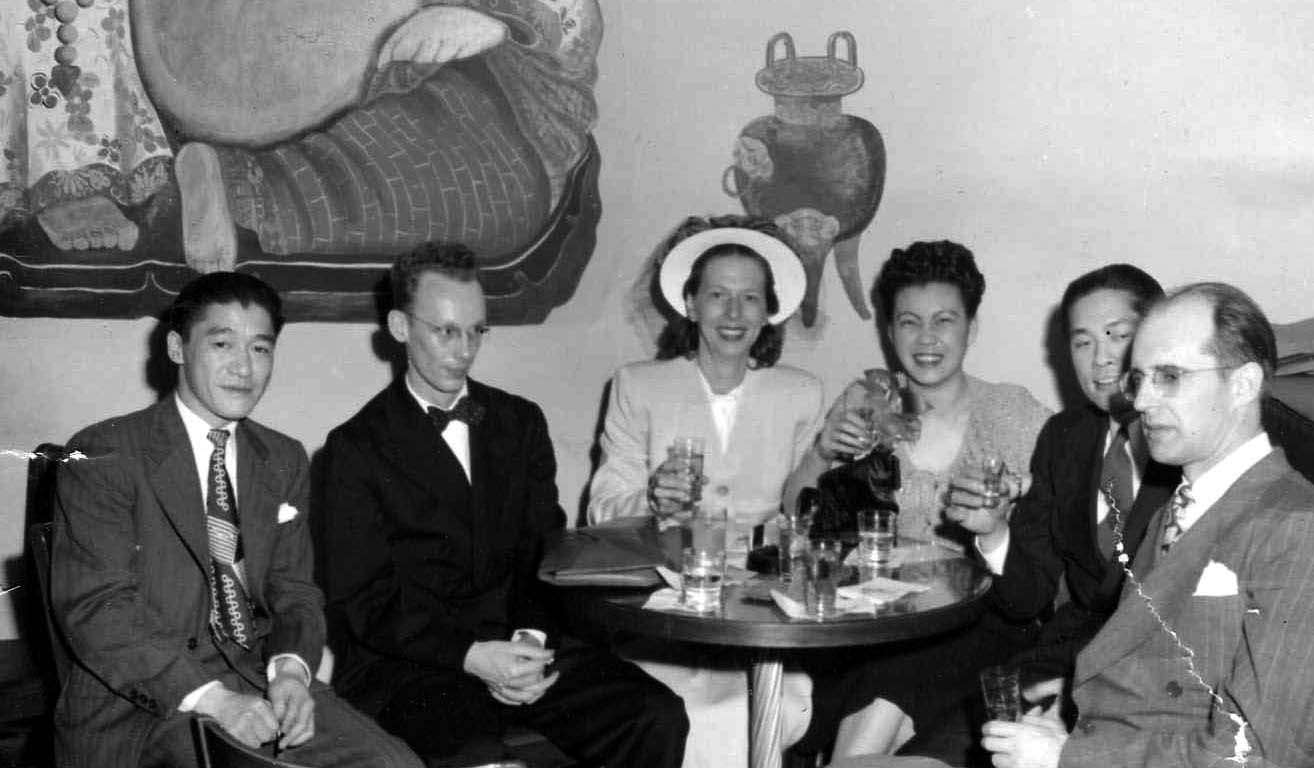
My parents (on the right) and friends at the Wah Mee Club, Seattle.


BACK FROM THE ABYSS--Ti

Main Entry: abyss

Pronunciation: \ə-ˈbis, a-alsoˈa-(ˌ)bis\

Function: noun

Etymology: Middle English abissus, from Late Latin abyssus, from Greek abyssos,from abyssos, adjective, bottomless, from a-+byssos depth; perhaps akin to Greek bathys deep

Date: 14th century

1. the bottomless gulf, pit, or chaos of the old cosmogonies
2 a. an immeasurably deep gulf or great space b. intellectual or moral depths

http://www.merriam-webster.com/dictionary/abyss

I knew what I was getting into when I agreed to come to this island. I didn’t expect to greeted by every islander with open arms (though many did), nor to be accepted at every social gathering (though I was grateful that people made an effort to include us in community events).

This was not the first -- nor will it be the last -- time that I have taken a wild leap off into space. I’ve had more jobs than I can count. I’ve met my relatives in Kwangtung Province and in Mongolia. I’ve sailed around the world at least twice. I’ve survived de-masting in the Tasman Sea and a sinking fishing boat in the Georgia Straits.

Even the “sports” I favor--sailing, paragliding--ask me to tack off the edge of the earth, or to literally run off a cliff and leap into the abyss. In my mind, I am taking risks, having adventures, making quantum leaps, moving forward by cutting all ties with the past. I love the abyss, the unknown.

But ask my oldest friends what I’m doing and they might raise an eyebrow and say that I run away just as I am about to be successful, that I do something different rather than actually succeeding.

Make my living as an artist, as a photographer? I’ve had every opportunity and I’ve taken very few of them. When I was fresh out of college I marched into the Seattle Post-Intelligencer with my portfolio and announced that I wanted to do a photo essay on Seattle’s rapidly changing Chinatown. I got photo releases on P-I letterhead and shot 10 rolls of film. I still have the proof sheets. The photos are good. There are lovely images of my Chinese elders, old storefronts, signage, and the community garden. The images capture a transitional time in the International District. But I never went back to the P-I with my work.

A big revelation came when I did an intervention with my mother. She had been a heavy drinker all her life and I finally truly wished to know—or so I thought—what she was like when wasn’t drunk. In retrospect, I was more interested in being in control than having my mother stop drinking.

My parents and their friends regularly tied one on when we came to Seattle—twice a year, to stock up on Chinese groceries. They’d leave me in the Milwaukee Hotel and go drinking and gambling at the Wah Mee Club. I was quite safe at the Milwaukee—the elders would check on me, leave peppermint Life Savers under my pillow. My parents would roll back to the hotel at dawn, giggling, smelling of cigarette smoke and booze. They’d check on me and have a nightcap.

Things changed after my dad died. I was fourteen when he chose suicide over losing his soul to brain cancer. My mother blamed herself for his decision—she never should have left the house to go Christmas shopping. After his death, she drank more and more until she was hardly ever completely sober.

But my mom wasn’t a drunky villain.

Her parents died when she was five years old and she and her sisters grew up in the Ming Quong Home for Chinese Girls—both what she called the “old home” on the campus of Mills College and the “new home” in Oakland.

Her oldest sister said that their mother would take them to be extras in various Hollywood productions—silent films. I’ve looked for them in old films. Sometimes I think I’ve seen them, but I’m not sure.

My mom had polio before I was born but taught me to ride a bike and to roller skate by giving me verbal instructions. She was constantly taking apart things that had broken (the toaster, the heater, the air purifier) and fixing them, as we didn’t have money to buy new stuff.

She had wanted to be a photographer and still had her Argus C3. Dad bought her a Brownie Starlight. I started taking photos with the Brownie when I was six years old. I got to use the Argus when I was twelve. My early graduation present was a 35mm Honeywell Pentax.

Mom stayed a couple of days in rehab and told a big lie so she could leave. I’m sure the rehab folks were used to hearing lies. I was so mad that I didn’t talk to her for six months. But it was also a big “ah-ha” moment for me. My mom had, consciously or unconsciously, taught me to get myself out uncomfortable situations by lying.

I decided to change—and once I changed one thing, I had to change—everything. I adopted my dad’s favorite catchphrase: “Tell the truth, walk your talk.” It took a long time to say “no” when I meant “no” and even longer not to come up with a string of lies (told mostly to myself) about why or why not I could or could not do something.

My mom did stop drinking, all on her own, and at the age of 65. I have the photo I took of her the summer before she died. She put everything she had into the look she gave me through the lens of my Nikon.

My mom and dad had succeeded in raising a physically fearless daughter, and gave me every skill they could to succeed.

Which brings me back to this island.

Moving here was another step off into the abyss for me. I had run into a brick wall at KCTS. My department had been eliminated and I’d just spent weeks sorting and filing 50 years’ worth of materials. I’d been at the station for ten years.

There were other jobs I could do at the station, but I was tired and frustrated and it was time to move on. I organized my list of clients, emailed everyone I’d worked with in the hopes that some freelance work would filter in, quit what had been my dream job and cashed out my 401(k).

Did I run away again? Maybe my friends thought so.

I ruefully realized that though I now had the time to work on being an artist, I was out in the middle of nowhere. But the art workshops were in town. My support group was in town. Hell, my camera, paints, drawing board and easel were all in town.

I’d kept my Seattle apartment.

Hedging my bets?

Yep.

Back from the Abyss -- Kristi’s Story

By the end of that first year, things had gotten rocky in Shangri-La. Bill and I fought all the time about money, kids, chores, and his latest obsession de jour whether it be fishing, music, the weather channel. But mostly we fought about the cabin. He thought it was great and couldn’t see what my problem was. After living in his little trailer with limited electricity and running water, the cabin felt like a regular palace to him. Plus the mortgage was relatively cheap.

I, on the other hand, had started to hate our “little log cabin in the woods” with its small windows, dark rooms, cranky plumbing, cold floors, smoking wood stoves, and decades of layered on yuck that no amount of scrubbing would clean. I cried regular tears for the tidy, bright little house I had left in Seattle. I knew I needed light and a more comfortable home. If I had to spend another winter in that dark place I was sure I’d lose my mind.

Finally we went to a marriage counselor where Bill heard a revelation. “Eighty percent of the problems we are having in our marriage are because I’m so unhappy in the cabin,” I announced. Bill looked at me in shock. “Eighty percent? Really?” He slowly absorbed this fact. “You mean more light and a newer home would mean a lighter, nicer wife?” “Yes,” I replied. And that was all it took. All of a sudden he was on board with my need for change. “I want a happy wife.”

I realized getting a new home would be no easy task, and, in fact, it took us years to fine a new home. But at least I finally felt we were working more closely as a team. Bill had always wanted to build his own straw bale home, and we started exploring designs. We visited properties, discussed possible models and couldn’t agree on a thing. He had been planning his straw bale home for so long that any suggestion I made was an intrusion and immediately rejected. Many a marriage had ended in this valley under just such circumstances. Building a dream home can be hell, and I wasn’t sure our marriage would survive the project. So we explored other options such as ways to bring more light into the cabin (solar tubes?). We put in a newer wood stove (less smoke). Bill did a major remodel on the one corner room in our cabin that occasionally got some light to use as my office. He put in new windows, sheet rock, wall paint, flooring and rugs so that it almost, almost looked “normal.” I loved it!

Not only that, but I was beginning to get some decent work and was actually making money. Contacts I had made at KCTS came looking for me to do outreach for their projects. On occasion, I could even hire some of my cool former colleagues like Ti, to design and work on different aspects of my campaigns. I was connecting with my former tribe, doing work I loved again, and for awhile, we weren’t even poor!

Making friends in the valley was still a little problematic, but I found out it wasn’t just a problem for me. There were lots of little cliques in the valley and they were hard to break into. One woman I met had tried to join a book club when she had first moved here but the club wouldn’t let her in. They told her they were full. So she went and started her own book club and that’s the club I joined. I liked the idea of being in the outlier group.

I had a similar experience when I asked if I could join a group of women who rode mountain bikes together. They all looked at me blankly until one finally said, “Well do you even own a mountain bike?” I must have looked at the woman funny thinking, “Why else would I ask” because she just turned and walked away. So much for the bike club.

My big break came when a tall, striking woman whom I met at the local Montessori, started telling me her own hard-to-make-friends stories. It turned out she had been rebuffed at least as much as I. “What is the deal with this place?” I asked. “It seems like high school again,” to which she quickly agreed. Finally, after much more discussion and laughing about our various run-ins with non friends, she came up with a brilliant idea. “I’ll be your friend if you’ll be mine?” she asked in a serious tone. “Deal!” I said. And my first real friendship in the valley was formed.

In truth, we may not have been friends had we lived in our old worlds; Seattle for me, a rich suburb for her. We didn’t share a large set of interests or friends and our politics didn’t always mesh. Our backgrounds were different, as well as our careers, our incomes, and our lifestyles. In short, we weren’t that much alike. But I hadn’t met anyone like me here, nor she anyone like her. So we decided to be oddballs together, and that has served us well.

But the most striking thing that changed my life here in the valley was the arrival of my third child, Jannie; the baby that wasn’t suppose to be. A year after we arrived I had almost bled to death due to a run-in with my IUD that caused me to lose 50% of my blood. After the second rush to the hospital (nearly an hour away), the doctors preformed an emergency D and C. My hemorrhaging stopped, but the doctor said my uterus was probably so scarred that I would likely never have more kids. We were sad as Bill had never had a child of his own and we were thinking we might try. But he enjoyed being a step-father to my girls, and I was fine with two kids. We threw away all birth control and basically forgot the whole thing. Until two years later when I noticed I wasn’t quite feeling right, and my symptoms were vaguely familiar. “Naw,” I thought. “It couldn’t be.” But just on the off chance, I decided to use a home pregnancy test that I had left over from a former time, and low and behold….”Hey honey,” I said, as I walked in on Bill chopping vegetables in the kitchen, pregnancy test in hand. “Do you see one line or two? I think I see two…” His eyebrows shot up and there was a moment of stunned silence in the room. “Does this mean…?” he slowly stammered, as a goofy smile started forming on his face. Bill was going to be a dad.

Wednesday, February 9, 2011


REALITY HITS--Ti

Three Questions

My dad had a “three questions” rule. I could ask him three questions and only three questions if I was wondering about something. (I could not ask for more questions.) I had to think very carefully about my three questions and usually, after thinking, observing and pondering, I answered my own questions.

Question #1: Did I uproot my life for love?

No. Yes. I don’t know. I understood that my not-yet husband was trying to make a new and different life for himself and his daughter. I understood how challenging that would be for the two of them.

Question #2: Then why am I here?

I think I came here out a sense of responsibility. I’m here because they needed me. The first thing I did when I came to the island was post the dinner menus for the week. It was one tiny bit of consistency; a thing missing from their lives. My sweetie and his daughter looked at that list a dozen times a day. No matter what, every evening at 6:00 p.m. or thereabouts, dinner would be ready. I fed them non-stop: breakfast, lunch, dinner, snacks. They were certainly ready to be nourished.

Question #3: How long will I stay?

I don’t think folks had much hope for us. Maybe they thought we’d turn and run for town as soon as it winter hit. Or if offered the opportunity, the kid would go back to her city life. The first big school event in the fall brought two sets of grandparents, the kid’s mom, and mom’s friend out to the island. I had the feeling that the kid could have left with them if she had wanted to. But she stayed. And so did I.

Trying to Get Married

I moved to the island in October, but we didn’t get married until December. I lobbied for a nice wedding: sunset, beach, maybe in the tropics, a couple of my friends in attendance, a nice dinner. I clipped pictures of pretty dresses from fashion magazines and pictured myself with gardenias in my hair. My friend Suz bought me a waffle iron.

We tried to set a wedding date and the venue fell through. We tried to set another and my friends weren’t available. We gave up and decided to get married in district court on the shortest day of the year. I called around and found four friends who could drop everything and come. One friend brought yellow roses and cedar for my bouquet. We did have a very nice dinner at a great restaurant.

New plan: our friends would join us on the longest day of the year at the restaurant and we’d have a little celebration. I sent out emails to save the date. A month before our celebration, the restaurant burned.

I can take a hint. No more planning of celebrations.

Embrace Failure…

Folks here are used to failure. Get a car out here and it’ll quit working. The new refrigerator will balk, the stove will blow up, and the boat will refuse to start. A 25-cent fuse ends up costing $60, once you’ve got yourself into town and back. You had better be a jack-of-all-trades and be prepared to fail.

Fail in the city and you can quietly leave, start over somewhere else. Fail here and everyone knows. Years later, they’ll still be talking about you. But island folks are pragmatic. They wait and watch and you can ask for help—up to a certain point. But on some level you have to show that you have the resources to solve your own problems. You take responsibility for living your life.

We live in the land of Murphy’s Law, Exponential Model: if anything can go wrong, it will… and if it only screws up twice, you’re doing pretty well. It’s not surprising that just about every man who actually lives on the island owns a backhoe or two. When in doubt, use the heavy equipment.

…and be Prepared to Do It Yourself

Solder copper pipes in 12-degree weather.

Fix the roof in in a storm with 45-mph wind gusts.

Dig a trench and run power out to the shed.

Fix the fuel filter in the truck, the starter in the boat, the carburetor on the ATV.

Grow your own food; shoot or catch what you can’t grow.

Leap three feet from a heaving boat deck to an icy beach, then field the bins containing a month’s worth of groceries -- tossed with great accuracy by my husband.

Motor the kid to the school bus stop (one island over) in freezing weather, 20 mph winds, and four foot waves--in a rubber raft.

Stand waist deep in very, very cold water, hanging onto a boat that’s half on the trailer because the winch strap just snapped.

Check, check, check and check. All in one week.

The Washing Machine and No-Power Blues

The ancient, inefficient, leaky washing machine died in December. It spewed gallons of water all over the floor, but there’s no insulation under the floor, so the water just seeped down to the ground below.

My island neighbors generously offered use of their washers and dryers. I packed up loads of clothes on the ATV and scooted to friend’s houses to do laundry, drink coffee and gossip. A dryer! What a luxury! I’d been hanging clothes above the woodstove to dry them.

Then it froze. The power went off. No power, no well pump. No matter. The pipes are frozen. I could hear diesel generators firing up all over the island. Our generator was broken.

I lit candles and Coleman lanterns. I unplugged the fancy electronic phone and plugged in the old mechanical phone. It rang immediately. “Are you OK out there? Do you need anything? If it gets any colder, come to our place.”

I cooked dinner on the woodstove, told the family that we could go to any one of a half-dozen houses if we needed to. I thawed snow on the stove and did the dishes.

What do you do all winter?

We live on a vacationer’s island. In the summer there are people everywhere, boats on every mooring buoy, planes zooming in and out. But by the end of October, I’d guess that 90% of the houses on the island are empty, most buttoned up for the winter.

In November the winter storm systems start booming in. If you live on an island, no matter which way the weather is coming from, you get slammed. A storm ripping down the Fraser River Valley hits one side of the island, a Pineapple Express slams us on the other side. A 60-70-80-90 mph gust sounds like a train roaring in the distance, it slams into the house, it roars off.

We hunker down. But after six weeks, the cupboards are getting a little bare. There’s no store on the island. No gas station. No coffee shop. Grocery shopping (any shopping) means a trip across Puget Sound. We do not have state ferry service. We travel on our own boats or planes; or use a water or air taxi service—when there’s a break in the weather. We check to see if neighbors need anything.

There is no garbage service—whatever we haul on, we haul off. We are very good at not making garbage.

In the summer, people ask what it’s like here in the winter, I say, “Cold, wet, dark and windy.” They laugh, and then they ask what I do all winter. I say, “Try to keep warm.”

They laugh.

I am not laughing. I am absolutely serious.


REALITY HITS--Kristi

In truth, reality had been trying to get my attention those first few months in the valley, but I determinedly ignored it. Like the time Bill carried me over the threshold of our old log cabin after we first arrived and I burst into tears. “Oh my god,” I thought. “What have I done?! Did I actually leave my cute sunny home in Seattle for this?” The cabin was dark and dirty and smelled like wood smoke. But I quickly recovered, pulled out the ten gallon can of specialty-mixed teal-green paint I bought at a trendy home store in Seattle, and began to paint. And paint. And paint.

The new color made a difference, but I could not escape the dark rooms and tiny windows of the old cabin. My solution? Stay outside! It was nice out there; so natural. So countryish! And between noon and one, you could even see the sun through the thick forest of pine trees that covered our property and hovered over our home. Wasn’t that nice? But if it was this dark in the summer, what would it be like in the fall, or worse, the winter….? Best not to think about it. So I didn’t.

Reality check #2 came in the form of the fabulous fishing phantom, otherwise known as my husband. Somehow it had escaped my notice that my husband was a hopeless fishing addict. He had gone fishing on occasion when we lived in Seattle, but it wasn’t easy to get to a good fishing spot. Not so in the valley with its many rivers and lakes full of fish. No sooner had we arrived in the valley and unloaded our boxes into our new home then Bill grabbed his fishing rod and vanished. “Hold it.” I thought. “Didn’t I have a husband around here somewhere?” And sure enough, eventually he would rematerialize like a ghost, grab a snack and vanish again in search of the next big bite. “Just an anomaly” I assured myself, as I slapped more paint on the walls. “He’ll be back and life will be everything I dreamed of. And isn’t it cute that he likes to fish? How countryish!” Reality refused to set in.

It did, however, successfully intrude on a day in late August when the temperature in the Methow dropped 50-degrees overnight leaving new snow on the high hills. Bill had mentioned getting wood for the winter, days ago, but I had only laughed. It was 100 degrees! Who wanted to think about wood? But I wasn’t laughing now. In fact, I was on the verge of tears.

Our cabin had a fire place, two wood stoves and no wood. Our propane tank had no fuel. It was raining and 50 degrees outside. By the time Bill got home from work that evening, the girls and I were freezing. As I started to complain about the lack of heat and how cold we had been all day, and what were we suppose to do, Bill took one look at us in our shorts and tee shirts and said, “Well you could start by putting on more clothes.”

I lost it. “I don’t want to put on more clothes!” I yelled. “I want heat in my home! I want switches that turn on lights and make rooms warm! I want a normal house!” Bill was looking at me like the alien I had become when my 9-year-old, Emily, quietly spoke up. “Um, mom? We have a fireplace and I saw a little wood in the shed. Maybe we could make a fire?” I looked at her and put my head in my hands. This city girl was in way over her head. A life of convenience had not prepared me for this. “Great honey,” I said, trying to sound like the adult I was not. “Let’s build a fire.”

From then on I decided to make peace with my heating system and learn how to use it. Necessity is the mother of invention, and I was the mother of girls that needed heat. So I committed to becoming the new “country me” and learn to make fires and chop wood. Bill had gone out to the forest and brought back nearly three cords of wood; an enormous amount to my eyes, and it all needed chopping. Which sounds easy enough, and, in fact, I did a pretty good job, up until the point I nearly cut off my right foot.

“How about if you cut the wood honey?” I sheepishly asked Bill given that I was supposed to help with this job. “We don’t both need to do everything and there are lots of other things I can do around here instead,” I offered. “Like what?” he asked, looking me over in my city shoes and nice slacks. “Um…” I’ll have to get back to you on that,” I replied, as I began to realize that I did not have the skills for my new life.

As summer turned to fall, the reality of what our move to the country meant began more and more to collide with my country living fantasy. Back-to-school shopping was a real eye opener, as our valley has few places to shop. School clothes had to be purchased in the nearest large town, which, for us, was four hours away by car, round trip. Shopping for school clothes and supplies took an entire day, from early morning to late at night, despite the fact that both my girls and I hate to shop. It was hell. In addition, Emily started third grade in her new school, and came home furious after the first day. “These kids are rude,” she announced as she threw her backpack onto the floor. “What do you mean?” I asked.

“They pick their noses and wipe it on their pants, put gum on their chairs and spit,” she announced.

“They spit?” I asked, truly shocked as I thought about the well-groomed, high-tech, children of professional parents that attended Emily’s north end school in Seattle - where children did not spit. “Give it a little time,” I said, reassuringly, even as my own concerns rose. Emily had gone to the best public elementary school in Seattle; one parents clamored to get their kids into. We had visited the local school district before moving out to the Methow, and the teachers had all seemed great. The district was tiny, less than 700 kids, and the classes were wonderfully small. But I didn’t think about the kids. What if they really were a bunch of rude country yahoos and Emily ended up hating it here? “The kids will just take some time to get used to. They’re fine. You’ll see,” I said to my dubious child. I just hoped in my heart I was right.

There was another big reality check I experienced that first fall: Hunting Season. You can always tell when deer hunting season hits because all of a sudden you can’t find a can of beer, loaf of white bread, or package of wienies in the local grocery store. You also start to notice large numbers of men in camouflage gear along your road, scoping the deer in your front yard. And who knew that for approximately two weeks in October, local people tend to wear red so they won’t get shot when they walk on trails. Some local ranchers actually take to writing HORSE and COW in bold letters on the sides of their livestock so that hunters, using long range rifles from a mile away, won’t shoot them by mistake.

One morning that first fall, I woke up to the sound of bullets whizzing past my bedroom widow. Someone had shot a deer in my driveway. I went tearing out of the house in my bathrobe with my husband yelling after me, “Stop! You’ll get shot!” The site of a crazed urban chick in a red robe swearing like a sailor, all wild hair and eyes, must have been sufficiently terrifying because those guys took off fast. But they left the deer carcass for my kids to walk past on their way to the school bus that morning. The local fish and game guy finally hauled it away. If that same thing happened now I would probably have Bill haul the deer to the local butcher. I’ve learned not to waste food in the country. But back then I was just mad. What a waste of good meat.

Then, as fall turned to winter that first year in the valley, another harsh reality struck. Snow. I love snow but that’s an easy thing to do when you don’t have to live in it. And this valley gets a lot of snow. We measure it in feet, not inches. This was actually an attraction to me as I love to cross-country ski, and our valley has over 180 kilometers of groomed cross-country ski trails – the second largest cross-country ski trail system in the nation. But that was little consolation as I white-knuckled my car and my two children through yet another blizzard and two mountain passes in the winter so they could see their dad. Our new parenting plan required that we make this trip at least once a month, rain or snow. On good days in the winter, it’s at least a five hour trip to Seattle from here one way. It can take hours, or even days more, if the passes close and you are stuck up on top of a mountain until: a) an avalanche is cleared; b) a fatal car accident is investigated; c) a storm passes and the roads are plowed..

I learn to pack supplies for the trip: Chains, flashlights, sleeping bags and blankets, extra food and water; picks and shovels. I feel like I’m heading out to climb Mount Everest every time I take my kids to see their dad.

I learn to watch the weather and how to read weather maps. I have never been so impacted by the weather in my life. In the city, I could go days and not even know what was happening outside, or care. Here, not being prepared can cost you your property or even your life.

Reality also hit in more minor ways. Unlike Ti, we have garbage collection service, and I note what a privilege it is to have someone else haul away my trash. The same was not true for recycling when we first arrived. But after a decade of saving and sorting my paper, glass, and plastics in Seattle, I just didn’t have the heart to send them to the landfill. However the nearest recycling center was over an hour away. So we put the stuff in piles in our three-bay shed, just waiting to be hauled to the recycling center. Nine months later it’s still waiting, and our pile of plastic, paper, and glass has grown to fill two of the three bays of our enormous wood shed.

“This is not recycling,” I complain to Bill. “This is storage. God forbid anyone should light a match anywhere near all this dried up junk or it might all go up in smoke and take our cabin with it.” Which, as I started thinking about it, suddenly didn’t sound like such a bad idea…

Fortunately for our cabin, a local group established a recycle center some years ago. I’m thankful every time I only have to haul my recycle one mile instead of sixty. But the real lesson here has taken me ten years to learn: Use less stuff. That’s not a lesson people are forced to learn much in the city where someone else takes responsibility for your trash and hauls it to a place you never see. That’s less of the case in my world, and not the case at all in Ti’s. Your trash is, well, your trash. If you don’t want to deal with it then make less in the first place.

But this is a small inconvenience compared to the biggest reality check I’ve dealt with since moving to the country which is…..drum roll please…. Health Insurance!

Big surprise that; at least I know it was for me. Who knew the biggest stress of moving to the country was wondering if I could afford to take myself or my kids to the doctor? They never mention this stuff in those simple living guides, but for many of us out here, it’s the truth.

Like most Americans, I lost my health insurance when I left my job. I had always been insured through either my parents or my work, and just assumed we could buy health insurance somewhere when we moved. Since I never actually had to purchase health insurance before, I had no idea what it was like. But my shock at the system (or lack there of) grew rapidly after making our move.

When we first moved out to the valley in 1999, for example, we couldn’t even purchase health insurance on the open market. All the major insurers had pulled out of our side of the state because the population base was too small to profit from, and there was no private health insurance to be had. I was dumfounded. “I have money to buy a product and I’m being told I can’t have it? That’s just un-American,” I thought.

Fortunately (or unfortunately) our income at the time qualified us for Basic Health, the state sponsored medical insurance “for the poor.” That was us. But being poor and accepting charity did not mesh with my vision of moving to the country, though it appears to be the reality for many. The fact is there are very few jobs where we live that offer health insurance or any kind of benefits at all. Not only do most of us not get health or dental insurance through our work, we don’t get paid vacations, retirement, or even a single paid day off. If we’re lucky, we make a living wage – but many of us don’t even get that.

The exception to the rule is government work: Town, county, state, federal, teaching, law enforcement, whatever. Those folks usually get good bennies. Or if you’re one of the many people who work (or spouse works) at a good job outside the area and commutes back to Shangri-La on the weekends. That happens too. But if your thinking of moving to the country and want to keep some semblance of a safety net around yourself, either look for government work, figure out a way to make A LOT of money, preferably online, or do what local families do – give up your notion of a safety net. That’s what community is for.

My mistake was to start consulting and make too much money to qualify for Basic Health anymore. Not a lot of money, mind you. Just enough to get booted from the program. Fortunately, we got kicked out just as the insurance market moved back into our area. Unfortunately, the private insurance available was, and still is, expensive and poor quality coverage. Every year for the past ten years we’ve seen double digits increases in premiums, an increase in deductable and a decline in services covered. We were finally priced out of the health insurance market all together, and, for the first time in my life, I am uninsured. Fortunately, the girls qualify for SCHIP – the federal health insurance program for kids. But it’s back to that being poor/charity issue again. This is not what I thought my life would be.

The final reality check on moving to the country happened a year after we moved when I had to give up my kids so they could spend the summer with their dad. That was part of the agreement when I moved, but it felt like someone had ripped out my heart. The first day they were gone I could hardly breathe. Much of my identity had been tied up in being a mom. With my girls gone, I didn’t know who I was anymore. I missed my colleagues at KCTS and my old career. My house was still dark and smelled like smoke. Between his work, his fishing, his music jam sessions and his friends, my husband was hardly around. And I was having a hard time making friends; something I couldn’t figure out. Did I smell bad? Suddenly grow two heads? Wear the wrong kind of shoes? I had never had this problem before. But all of a sudden, it felt like one problem too many and I began to seriously question what I was doing with my life. This was not what I had planned when I decided to move to the country. This was not my wonderful life.
Wednesday, February 2, 2011

HOW WE GOT HERE--Ti

I’d been on this island before, though it took me a long time to remember when. The “first” time I approached the west beach from the water with my not-yet-husband, it looked familiar. The old road and little bridge were over there, that tree was here…but wasn’t it farther back from the water? The shoreline had eroded—a lot--several hundred feet in one place. But yes, I’d been here before.

When I was very young, my father brought me here with Lummi and other tribal elders to look at shell middens. The middens are thick piles of discarded shells—the result of decades—centuries—of the tribes coming to the shoreline to gather shellfish. At one time, people were forbidden to build homes over the middens because of their historic, tribal and archeological value. My dad and his friends were trying to locate as many of the middens as they could in the hopes that folks wouldn’t build houses directly on top of them.

I remember the midden on our beach because one of the elders showed me how camas (Camassia quamash) had been planted near where the shellfish were gathered. When families returned to this shore to gather shellfish, the camas would be right there too, making gathering food a bit easier. The ten-foot-thick shell deposits are still here and so is the camas. However, the shoreline is eroding back so fast that I have been gathering the camas and planting it in my garden.

I’ve known my husband for a long time, though we were not each other’s type when we were younger. But we got older and I suppose we started thinking, “Hey, you’re not so bad after all.”

By the time he finally convinced me to marry him and move to the island I was decidedly not a young starry-eyed bride. And he was no Prince Charming with a castle. He had to offer: (1) a creaky old, dark, and uninsulated building on an island with no ferry service; and (2) an 11-year-old daughter. Oh joy, at an age when most women are thinking about retirement, I am about to move back out into the sticks and be a stepmom.

But still, I said yes.


HOW WE GOT HERE--Kristi

The Wild Woman’s Whitewater Rafting Adventure was an annual event with my group of single mom friends. We would head out to a remote, pristine little Shangri-La located in the North Cascades mountain range in Washington State, approximately forty miles south of the Canadian boarder as the crow flies. There we would raft the main river over Father’s Day weekend when the water was running high and we knew our kids would be with their dads.

During these trips, we usually encountered an adventure or two, like the time one friend in her short cut off jeans and cowboy boots attracted the attention of one too many cowboys. Or when I fell out of the raft during a class four rapid, was sucked into a hole and saw God. We somehow always managed to survive with only minor scrapes and more than a few hangovers. But one year was different.

That was the year, after drinking one-too-many chocolate martinis, we all decided to pile into the red jeep and see what sort of trouble we could get into at the local cowboy bar. And that’s where I met Bill, a quiet, handsome, long-haired hippie; the future love of my life. He had uncharacteristically come to that notorious bar to hear a band he liked, and was casually standing in the corner sipping a beer, when he caught my eye. There was something quiet and gentle about his demeanor that appealed to me after years of being married to someone who was not. Plus I had vowed to be the first “Wild Woman” out on the dance floor so I asked the quiet hippie to dance. Or, rather, I dared him to.

“Are you going to stand there all night drinking, or do you want to dance?” was my now-famous opening line. Why he didn’t run for the hills is anyone’s guess, but dance, we did, and then we talked for hours. In the following weeks, we began a steady correspondence, back-and-forth visits, and a cross-mountain romance.

Three months later, Bill was living with me and the girls in Seattle. And to this day, we’re still not sure why we clicked so well. We just did. The girls loved him, I loved him, and he loved us back. We wanted to build a life together, and somehow, I knew that we would.

But Bill did not love Seattle and often missed his valley home. His passion was nature, sustainable building (he was a carpenter by trade), and living a simple life. My passion was my career, my kids, and maintaining my complicated life. I had no idea how to make it all work. But I had just started an outreach campaign around a documentary on voluntary simplicity, and the idea of downsizing my “stuff”, working less, getting out of the city, and having more time with my kids was increasingly attractive. Bill encouraged me to explore where that road might go. He also maintained his home in the valley: a tiny trailer on 30 acres with an amazing view, where we would regularly visit. I have always been a city girl, but each time we went I felt a little more comfortable with the primitive lodgings, wide open skies, and miles of mountains and woods. I knew Bill was hoping we could all move to the valley someday but I wasn’t ready.

At the same time, my life in the city was becoming more and more untenable. I had a new boss who wanted me to go from conducting large, impactful outreach campaigns to writing her personal memos. I had to refinance my home to buy out my ex- husband, and was now living beyond my means. My bills were piling up, the freeway was always clogged, and my kids were in daycare (or school) ten hours a day. Traffic, stress, and guilt began to work their magic until one weekend in the valley, as Bill and I were sipping coffee in the sun on a bed of warm pine needles, and taking in his incredible view, I finally said, “Okay, let’s do it. It’s time to move.” Had I known what I was getting into, I might never have uttered those words. But looking before I leap had never been my strong suit, and leap I did.

Three months later we had sold my home, quit our jobs, negotiated a new parenting plan with my ex-husband, got married, and bought a tiny 1904 log cabin on several wooded acres in our valley paradise. I was ecstatic! Not only was I getting away from my ex-husband, tyrannical boss, high housing costs, and mind-numbing traffic, I was also living in a beautiful environment with low over head, a wonderful man, and more time with my girls.

Bill was thrilled to be home and found work easily in his trade. I had some savings after selling my home, and could afford to take a little time to figure out what I was going to do with myself. My youngest daughter, Rose, was four years old when we moved, and had been in full time daycare since she was one. I was thrilled to have the time to get to know my kids again.

That first summer, Emily, my eldest (age 9) spent the summer with her father in Seattle, the youngest, because of her age, spent that first summer with me and Bill in the valley. Em came home and started public school in the fall, while Rose went to the local Montessori. There was no getting up at 6:00 a.m. to hustle them to daycare, no long commute in terrible traffic, and no stressful job. Em had a 10 minute bus ride to school, which picked her up in front of our door. Rose went to half day Montessori and spent the rest of the day with me. Bill worked and earned just enough money for us to get by. We were happy, in love, and life was good.