Monday, July 16, 2012

Induced Comma

I like offbeat punctuation marks, like the interrobang. I can see the crying need for the sarcasm point (an inverted exclamation point) and the pomma --“you’ve been punk’d” – point (an exclamation point lying on its side).

And I come up with the occasional oddball typo – this week it was “She was in an induced comma.”

How does one induce a comma?

Starting with a definition of terms -- because I was on the debate team in high school and the defintion-of-terms was always the first step in research. I get to visit my old friend, the American Heritage Dictionary (AHD). I love the AHD because I am a geeky closet linguist -- my, but that sounds naughty -- and the AHD gives the Indo-European roots of many words.

Induce means “1. To lead or move, as to a course of action, by influence or persuasion. 2. To bring about or stimulate the occurrence of; cause..." (There are other meanings for biochemistry and genetics). [Middle English inducen, from Old French inducer, from Latin indcere : in-, in; see in-2 + dcere, to lead; see deuk- in Indo-European roots.]

Finding the root words in English is a fun puzzle and deuk- is one of those roots that has dug in all over the language, forms the root of everything from the Middle English tuggen (to draw or lead) to the Latin ducere -- dock, deduce, introduce, it is also the root of the Latin educare -- lead out, bring up (educate) -- and intriguingly, the root of the Old English team (family, descendant, race, brood).

The definition of a comma, again from the AHD: 1. Grammar A punctuation mark ( , ) used to indicate a separation of ideas or of elements within the structure of a sentence. 2. A pause or separation; a caesura. 3. Any of several butterflies of the genus Polygonia, having wings with brownish coloring and irregularly notched edges. [Latin, from Greek komma, piece cut off, short clause, from koptein, to cut.]

And "coma" is from the Greek koma, a deep sleep. As in American English, a single "m" separates a pause from a sleep.

With my induced comma: I can lead, move or education people to – pause.

And as for using commas, I can't say it any better than The Comma Project --

“Put a comma in whenever you take a breath.

Almost everyone I know has heard that particular comma rule, or some variation of it, and that is unfortunate because the rule is unreliable at best and, at worst, simply wrong. But the rule does make sense in a historical context, and that may explain its longevity.

In antiquity, texts were usually read aloud or recited from memory by orators, and so the rule that you “put a comma in whenever you take a breath” can be traced back to the earliest days of reading and writing. Some of the words that we now use to refer to punctuation marks, such as comma, colon and period, originally referred to subparts of a text, differentiating them according to their length and complexity.

Before the arrival of alphabets, ancient texts could not be written out—they were memorized and passed along through an oral tradition. Once texts could be converted into written symbols, they were usually copied down letter for letter—with no punctuation, capitalization or even spacing between words.

Punctuation marks got their start as a way of sorting out the confusion by, for example, breaking material into longer and shorter sections. Back then writers didn’t have to worry about punctuation, which was determined not by the person who composed a work or copied it but by the one who spoke it out loud..."

_____________

For more on punctuation:

Eats, Shoots and Leaves, by Lynne Truss

Pause and Effect: Punctuation in the West, by Malcolm B. Parkes

(This is an academic reference and is expensive!)

Monday, July 9, 2012

I Don't Read, I Edit

I edit everything I read. It's a horrible habit, one I understand I share with other editors, writers, librarians and English teachers. (I might be doubly cursed because I was an English teacher too.) I start making mental notes about character development, arc of action, verb tense. If it's non-fiction I look for citations and cringe if I see they're from Wikipedia and no where else.

Don’t get me started on punctuation.

One of the few books I don't want to edit is The Remains of the Day by Kazuo Ishiguro; every word, scene and action seems to be as good as it can be. I read the book aloud to my AP English students in 1990, shortly after it was published in the US. I told them nothing about the author and asked them to formulate hypotheses about who the author might be; they were astounded to find out that the author was not a retired butler, but a born-in-Japan, lives in the UK author who as far as we knew, had never been a butler.

One of those students is now a screenwriter. Though she said not to dignify her work as “screenwriting”. “I prefer... hack,” she said in her email this morning.

We have been discussing editing. She says she’s the servant of many masters, over-edited to the point of paralysis. We couldn’t decide which was worst – too much or too little editing. How do we know when the editing is “just right”? I‘d like to say that we know it when we read it, and I do know that it is a collaborative process between the author and the editor.

Unfortunately it is far too easy to “publish”. Don't Publish That Book! includes a hilarious interview with Lou Morgan, who can't stop reading his first written-as-a-teen manuscript because it is just... so... awful. Morgan and the others chatting on Suw Charman-Anderson’s blog thought their writing was so great -- and it wasn't -- and that they were glad that self-publishing was very difficult back then.

Suw Charman-Anderson writes, "If there’s a common flaw in self-publishing, it’s that too many books are published too soon. Experienced voices across the publishing world continually advise self-publishers to get help with editing, and not just copy editing but story editing too. It’s difficult, if not impossible, to properly edit your own work. But the siren call of the Kindle store is often too seductive. The urge to finish your first draft, chuck it through a spellchecker and release it in to the wild is often far too strong for eager writers to resist.

But resist you must. Not resisting results in your name being married, permanently, to sub-standard work which doesn’t show off your talents to their best. Do you really want, in five or ten years time, to look back on your early work and cringe? More to the point, do you really want your first act of publishing to result in the irreversible blotting of your copybook with your potential fans?"

________________________________

Next week: the induced comma and other typos...

Monday, July 2, 2012

PROLOGUE & EPILOGUE

What happened to the wedding and the anniversary couples? Is there a coda, an epilogue?

I looked for their names on Google, checked their hometown papers, did some searching using ancestry.com and found – not much. The anniversary couple lived to celebrate their 75th anniversary and passed away with a few months of each other a few years later. The wedding couple stayed married, or at least they were as of the last census in 2010. Not much, certainly not enough for an epilogue.

When I hear “epilogue” I always think of the TV show “The FBI”*, which was divided into acts and ended with an epilogue (OK, they spelled it "epilog") that showed what happened to the criminals featured in the story. I always made sure that watched the epilogue; I wanted to know what had happened to the bad guys. Were they sent to prison? I could be pretty sure that they were, but I watched anyway.

The “Als” (see post, from May 20, 2012 ) did not like epilogues or prologues. Al insisted that stories begin in the first chapter and end in the last, no exceptions.

For example, let's say there's a man on the run. He writes ARTXCV in the dirt of the garden bed where the protagonist is about to plant carrots and runs away. His actions start the story -- the author uses a prologue, we are dropped right into the action, the reader is omniscient. We know slightly more than the protagonist does.

However, the Als would have me edit the prologue out: Chapter One, sentence one -- the protagonist finds ARTXCV in her garden and “wonders what the heck”? We’re dropped right into the action but we don’t know any more than the protagonist does.

Most of the time, and for most genres, I agree with The Als. I have seen far too many manuscripts where the prologue is ten pages of backstory and the epilogue ten pages of “…and after that, they….”

In contemporary fiction, the prologue and epilogue should be almost inconsequential. They add a spice and depth to the body of the story, but if they were taken away, the story would still be complete. The author shouldn’t be framing the story in the prologue. The premise of the story shouldn’t be in the prologue or the resolution in the epilogue. Those things -- frame, premise, resolution – happen in the meat of the story.

However, if you happen to be writing in the style of an old drama or opera, then the prologue is where a performer will summarize the action to follow (see definition below). Though I would quickly edit out text that read, “Here we are in the wasteland to tie Prometheus to the rocks ‘cause he made the gods mad….” – this is how classic Greek drama starts. Prometheus Bound (Aeschylus, 430 BCE)

In opera and older stage drama, a performer will also often summarize the action in an epilogue. Think of Hamlet in which Horatio starts his epilogue with: “The rest is silence. Now cracks a noble heart. Goodnight, sweet prince/and flights of angels sing thee to thy rest.” He then speaks with Fortinbras and the play is summarized in about twenty lines.

_______________________________

prologue often US, prolog [ˈprəʊlɒg] n

1. (Literary & Literary Critical Terms)

a. the prefatory lines introducing a play or speech

b. the actor speaking these lines

2. a preliminary act or event

3. (Music / Classical Music) (in early opera)

a. an introductory scene in which a narrator summarizes the main action of the work

b. a brief independent play preceding the opera, esp one in honour of a patron

[from Latin prologus, from Greek prologos, from pro-2 + logos discourse]

epilogue [ˈɛpɪˌlɒg] n

1. (Performing Arts / Theatre)

a. a speech, usually in verse, addressed to the audience by an actor at the end of a play

b. the actor speaking this

2. (Literary & Literary Critical Terms) a short postscript to any literary work, such as a brief description of the fates of the characters in a novel

3. (Communication Arts / Broadcasting) Brit (esp formerly) the concluding programme of the day on a radio or television station, often having a religious content

[from Latin epilogus, from Greek epilogos, from logos word, speech]

_____________________________________________________

* For more http://en.wikipedia.org/wiki/The_F.B.I._(TV_series)

For the opening http://www.youtube.com/watch?v=crCZtW7u-NE

Monday, June 25, 2012

Conflict

Last week I wrote about an accidental mash up of a wedding and anniversary celebration, which still ranks as the coolest event I've even worked at or attended. Almost everybody was very, very understanding; the anniversary couple toasted the wedding couple; the World War I vet shook the Vietnam soldier's hand and thanked him for his service... this was at a time when many men and women would slink back from service in Vietnam because there were folks in the airport chanting things like "baby killer".

But of course not everyone at the event was perfectly happy -- there was a fly in the ointment* -- an antagonist. In this case, it was one of the sisters of the bride, who was livid at the scheduling mix-up that resulted in two events being in the same place at the same time.

In this story, the sister-of-the-bride is the antagonist: she demanded to talk to our managers; and once she started complaining, there were a few titters of agreement from other folks on the scene, there were comments about withholding part of the payment.

Note this: the sister-of-the-bride didn’t blame us, the two catering managers; she was careful to tell us that she understood that we hadn’t scheduled the events; she was correct in asking to speak to the event coordinator. She was reasonable, she wasn’t raging drunk -- and OK, she’s a little boring as an antagonist. I’m really tempted to embroider on her personality, have her wearing an age-inappropriate flowered mini-dress and maybe waving a Mai Tai at me. But if I do that, I stray off into clichéd behavior.

Make your villain(s) real, with human characteristics your readers understand. Yes, most of us probably have an Aunt Martha who wears floppy hats and drinks too much at weddings. However, the reader wants backstory: why does Aunt Martha get drunk and tell embarrassing stores at weddings?

Why does the antagonist dislike the protagonist? Why was the sister of the bride so pissed off when no one else seemed to be? Why did a few folks speak up when she did? Were they all being sweet as honey until later, when we'd get sued?

There's another character in this story -- the event manager. The event manager had been on the job for about two weeks and she had not scheduled the two events. The other catering manager and I knew that she was a retired Army nurse and that she had set up and run field hospitals in Korea. We watched her serenely take charge and make the two events not only flow smoothly, but be memorable. She got the two almost-surplus mess tents there, she managed to come up with a string quartet for the wedding and a DJ who spun hits from 1920-1970 -- neither had been originally scheduled for either event.

She talked for a long time with the disgruntled sister-of-the-bride. Afterward, when we were cleaning up, the event manager said, “Well, I do think I've kept her from suing us all. She's mad that her little sister has married that boy; he dated her first. That’s got to be uncomfortable all around, right? The kids were going to get married quietly, but the family found out and they all flew in, arranged this surprise wedding, brought their mother's wedding dress and all. Our bride didn’t want to wear her mother’s dress, did you notice that she changed clothes in the middle of the evening?”

“Yeah she was wearing an old-fashioned thing in the beginning, looked hot and uncomfortable, I figured it was a good move change to a Hawaiian wedding dress.”

“Oh yes… well… the bride is pregnant – just barely. I’m sure that first dress was far too tight.”

"The sister told you all that?"

“And the bride. A lot of what a nurse does is listen.”

What happened to those two couples? Next week: prologues and epilogues.

__________________

*Ever had a fly in your ointment? Me neither. Fly in the amber might be the source of the phrase. For the origin of the phrase, see http://www.phrases.org.uk/bulletin_board/16/messages/870.html

For more on what makes a villain or antagonist real, see http://www.writersdigest.com/tip-of-the-day/writing-a-mystery-novel-creating-a-villain-5-ways-to-justify-a-crime

Monday, June 18, 2012

The Character Driven Story

Plot or event-driven stories often feel like World War II documentaries: “The Battle of the Bulge: the Allied Armies stand ready to invade Germany and….” Big sweeping events; military commanders gesturing at maps and making decisions that will affect thousands of people, maybe short cutaways to a soldier’s letters home.

Make a movie the battle and the story becomes character-driven: the battle from the POV of an American intelligence officer and a German Panzer commander. (Battle of the Bulge, 1965)

The story of World War II is both things--big overview, the stories of the individuals who fought. While interviewing WWII vets for a project I was struck at how similar the stories were -- although each man and woman felt that their story was unique, it was all the same story. I did 138 interviews and there were only a half-dozen that stood out – from men and a woman who had bucked the tide, protested the war, or resisted being drafted. Their stories provided the necessary counterpoint to the usual war story; ultimately the documentary was filmed from their perspective. (The documentary is no long available*, but the Antiwar and Radical History Project-Pacific Northwest covers the same material.)

Plot/event-driven story: I was a catering manager about a zillion years ago and a scheduling snafu put a wedding and a 50th anniversary party in the same venue at the same time. The other catering manager and I did the only thing we could -- we combined the events.

The venue was on a military base – the clubhouse off the golf course; nine holes of lumpy sand and grass. There were two parties of 300+ people each; they both couldn’t fit in the clubhouse’s “ballroom” at the same time. Rent a tent? Right-o. We ended up with two not-quite surplus mess tents. (And how we got those is a story worthy of a M*A*S*H script.)

The tents went up right outside the ballroom. One tent was a chapel; after the wedding the sides were rolled up and band(s) came in. The other tent was had two buffet lines and tables decked out in tablecloths and flowers. We set up a “cabaret” in the ballroom with round tables and chairs and –most importantly -- the open bar. About 200 people could sit down comfortably inside.

…and now the story becomes character-driven…

It was a surprise party for the anniversary couple; the husband was a veteran of World War I and he thought the mess tents had been brought in especially for him.

The husband-to-be was on active duty and in Vietnam; he has a one week pass; get married, have a short honeymoon as he was back to Danang. He saw the mess tents and laughed, said he felt right at home.

###

A plot-driven story, where the reader hangs on every event, not necessarily on the characters, is very challenging. Mystery writers often write from this perspective; the characters are trying to uncover the plot.

Nonetheless, the reader wants characters, someone to latch on to. The author decides who those characters will be: hero, anti-hero; leader, follower; quirky, boringly "normal" and so forth.

A fabulous plot with undefined characters will make your would-be editor will weep into her coffee. However, strong well-defined characters and a very thin plot can work, for example Seinfeld, the show about “nothing”.

However, never underestimate your reader's innate knowledge of how a story should go. I remember my third-grade students discussing Star Wars in 1977.

Kid #1: "I wanna be Luke!"

Kid #2" "I wanna be Vader. He's got all the power 'cause he's dark side."

Kid #1: "But Luke will win in the end."

Kid #2: "But Vader has all the power because he's dark side and light side. Luke doesn't know the power of the dark side..."

Kid #1: "But Luke has to win in the end because he's... good!"

Next week: conflict.

__________________________________

*Two projects that I worked on that are still in circulation, about the Japanese American draft resistance: Conscience and the Constitution and In Search of No-No Boy

Tuesday, June 12, 2012

Don't Go Breakin' My Heart


(Next week -- the character driven story.)

_______________________________________

One of my students finished her first novel and sent it off to five publishers, two accepted, she selected one… and what’s wrong with this picture?

She emailed me and said that publisher number two had asked her not to submit any more work. “But I was going to go with them from the second manuscript, did I do something wrong?”

Yes you did.

We editors know that authors often submit their manuscripts to several publishing houses. You want to get published. You spread your manuscript around like compost and somewhere lovely flowers will bloom.

Did you read the guidelines for submission? Did the publisher ask for NO MULTIPLE SUBMISSIONS? If they did, they mean it. Publishers will typically spend three-eight hours looking at each manuscript before deciding to offer a contract. Don’t waste our time. If you’re shopping your manuscript around, tell us. If it’s a great manuscript, it might jump to the top of the stack – or not. I’ve passed on great manuscripts because the author said they were also submitting to ABC Publishers and I knew that the story is a better fit at ABC.

Really, all we want you to do is be honest.

OK, so you followed the guidelines and it's been months since you heard from the publisher, despite polite queries on your part. Now what?

(1) Submit to another publisher, but tell them that La-Di-Dah Publishing is also looking at the manuscript. However, it's been six months since you submitted and they're not responding to your emails, etc. The second publisher may pass on your manuscript, or we may suggest that you withdraw the manuscript….

(2) Tell La-Di-Dah Publishing that you’re withdrawing your manuscript. If they don’t respond in a timely manner, tell the next publisher you submit to that you submitted to and attempted to withdraw your manuscript from La-Di Dah, but they haven’t responded. We may know that La-Di-Dah is like that and be very sympathetic.

Follow the protocol. If you are querying a publisher who allows made multiple submissions, say so: "This manuscript has been submitted to you, DFG Press and WXY Publishers."

Even though it seems like there are a zillion publishers out there, the publishing world is still a very small place. Editors often read for several publishers*; I once saw the same manuscript five times when I was a freelance editor. To be fair, that author stated up front that he was making multiple submissions; on the other hand, none of the five companies I worked with accepted the manuscript.

MULTIPLE QUERIES, SINGLE SUBMISSION

What if you’d really like to be published by ABC, DEF and GHI Publishers, in that order? You can try multiple queries, single submission, but to do this, you must do your homework. When is the publisher accepting submissions: year-round, monthly, quarterly? Line up the publishers you're interested in; figure out when you have to submit and what (query letter only, query letter and sample chapters), and state clearly in your cover letter that if you don't hear back from the publisher in (30 days, 60 days, etc.) that you will withdraw your submission.

The publisher's web site should tell you what their turn-around time is on submissions--if it doesn't, ask before you submit. If they say it can be 90 days or more before you hear from them and you don't want to wait that long, don't submit.

A SAD TALE

...that was the title of a manuscript submitted to the "Als" (see posting May 20) . The author had sent sample chapters and a cover letter to the Als, looking for an agent. The story was quite good; Al offered to represent the author. Ah, but the author had been shopping for agents; decided to sign with another agent. Fair enough, that’s business.

Al ran into the other agent and kept me entertained for a month with tales of A Sad Tale**. The author wanted the first agent to aggressively market the book to several publishers; after four months and no contract, the author fired the agent and hired another; and without firing the second agent, hired another. The two new agents found out and both resigned.

The author was effectively blackballed among agents and started representing himself, calling publishing houses big and small, whether they published the sort of manuscript he had or not. The author and the manuscript got to be a joke: "Seen A Sad Tale yet? Only a matter of time!"

The author eventually was published via a vanity press. I’d forgotten all about A Sad Tale, until I found three new copies of the book at a yard sale in 1998, about fifteen years after they’d been printed. The books looked like they had never been opened, all three covers inscribed, “To Don….” and signed by the author. The folks running the yard sale didn’t know who Don was or where the books had come from.

I sent the books to Al; he called me as soon as he got them. He was laughing so hard that I could barely understand him. “Been years since I thought about this guy,” he chortled. “He tuned up at writer’s conferences representing himself as an agent for those vanity publishing folks. That was their MO back in the day – you could work off some of the cost of publishing your book by getting other writers to sign. A pyramid scheme, right?”

Alice chimed in from the other phone line, “They had the most horrid reputation. The conferences wouldn’t let them in as publisher reps. They had to register as participants -- we couldn’t keep them from coming to the conferences, of course – and they’d try to do these back-door deals. Al and I did a workshop at the conferences – ‘Pros and Cons of Self-Publishing and the Vanity Press’ – and they’d come to the workshop and sit in the back and take notes.”

Al came back on, “And at the next conference they’d sign up under fake names and try to give a workshop on ‘self-publishing’; which was just a shill to get writers to sign with that damned vanity press. They were like crabgrass; they finally went away, but bingo, here’s that internet and they’re all over it. I’ll have Alice send you the what’s-it-called…”

“URL,” Alice said.

And there it was: Sad Tale Publishers**, formerly the V-Press, now owned by the would-be author.

A great post about multiple submissions, written by Durant Imboden http://www.writing.org/html/durant_imboden.htm http://www.writing.org/html/a_multiple2.htm

At the end of the posting is a link to another excellent article titled Those Terrible Multiple Submitters by Aaron Sheppard. The article was written in 1994 and is still accurate (and funny). http://www.aaronshep.com/kidwriter/A60.html

__________________________________________

*And not because editors are at a premium, I assure you. We have to work for several folks to get ends to meet. I make more money mowing lawns than I do editing.

**Name changed.

Monday, June 4, 2012

FORMULA


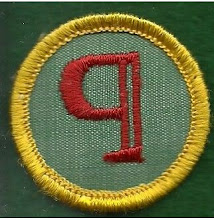
That's the Cadette (Girl Scout) Reporter badge that I earned 'way back when. I’ve wanted to be a writer from my earliest memory; and being a writer meant being a reporter – a journalist. I did and still do love the clatter of typewriters and the AP teletype, the smell and sound of the presses; ink on paper. Reporters can crank out stories fast and to length using the inverted pyramid: use the formula, plug in the info and go. Deadline: you've got ten minutes to write 250 words. Go.

The first writing formula I learned was the inverted pyramid used in news reporting. Who what, when, why, where and how in the first paragraph. Successive paragraphs reiterate what’s in the first paragraph. It’s all about what will fit; we cut stories from the bottom and if only one paragraph fits, the whole story is there. 

The Canal Street Warehouses were destroyed by a four-alarm fire early Tuesday morning. There were no injuries. Fire Marshall Joe Jones reported that the fire started in the fry house of Pete’s Potato Chips and that the cause of the fire is under investigation. Pete “Spud” Peterson, owner of Peterson Foods, was unavailable for comment.

I don’t get to write that Spud Peterson is a roaring drunk; or he only hired illegals; or his kids are in juvie, or his wife… you get the idea. That’s for the op-ed pages, letters to the editor or comments on the web page.

Writing a novel is vastly different. You don’t need to know nuclear astrophysics (just write a NASA astrophysicist into the story), the horses can talk, and people can be purple. You can write anything you want! Whee!

But will I want to read it? You have a better chance of finding readers for your work if you organize your creative writing -- thus, the formula. To be clear, in this blog entry I am looking at formulas that help writers generate a lively arc of action. Many of the manuscripts I read have fabulous characters and a muddled arc of action. I seldom see the opposite -- a great arc of action and boring characters. (More on characters next week.)

FORMULA ONE
What happens when in an arc of action can be broken down in several ways. One way to do this is in Story Engineering by Larry Brooks and is briefly summarized below.

  • How does the story open? Is there an immediate hook?
  • First plot point: the reader is  about a quarter of the way into the story and now the hero’s -journey, his agenda – changes. What happens to bring about that change?
  • Midpoint twist. Brooks calls this “parting the curtain” – for the character, or maybe only for the reader. What do we know now that changes everything?
  • Second plot point: the reader is about three-quarters of the way through the story. The hero should be driving the action—the reader should feel the ending coming up.

FORMULA TWO
I was a scriptwriter (and script editor) before I tackled writing novels, and I still use my old “beat sheet” to hammer out an arc of action. The beat sheet broke down what happens in every minute of a two-hour feature film. All the rising and falling action, all the journeys the characters take, and every revelation can be scripted to the minute. You probably know the beats. For instance, if you are a fan of House, you knew exactly when Hugh Laurie would have the revelation that solved that week's medical mystery.

A great published version of the script beat sheet is Something Startling Happens by Todd Klick. It’s a great read and you can use it to write novels – instead of each script page representing a minute of finished film; say that each minute is one or two or three pages of your manuscript – and there you are, a detailed outline of arc of action. 

Yep, these two formulas are the same thing, stated in different ways; remember that math analogy from last week? Remember: the formula is not there to constrict you;  it’s there so help you organize your information into a brilliant novel. That’s the deal between the reader and the writer; the writer will give the reader what they expect, but the action will speed up or slow down, the lovers don't quite meet, the dog stays lost... for now. 

The writer plays around with the formula.