Monday, June 25, 2012

Conflict

Last week I wrote about an accidental mash up of a wedding and anniversary celebration, which still ranks as the coolest event I've even worked at or attended. Almost everybody was very, very understanding; the anniversary couple toasted the wedding couple; the World War I vet shook the Vietnam soldier's hand and thanked him for his service... this was at a time when many men and women would slink back from service in Vietnam because there were folks in the airport chanting things like "baby killer".

But of course not everyone at the event was perfectly happy -- there was a fly in the ointment* -- an antagonist. In this case, it was one of the sisters of the bride, who was livid at the scheduling mix-up that resulted in two events being in the same place at the same time.

In this story, the sister-of-the-bride is the antagonist: she demanded to talk to our managers; and once she started complaining, there were a few titters of agreement from other folks on the scene, there were comments about withholding part of the payment.

Note this: the sister-of-the-bride didn’t blame us, the two catering managers; she was careful to tell us that she understood that we hadn’t scheduled the events; she was correct in asking to speak to the event coordinator. She was reasonable, she wasn’t raging drunk -- and OK, she’s a little boring as an antagonist. I’m really tempted to embroider on her personality, have her wearing an age-inappropriate flowered mini-dress and maybe waving a Mai Tai at me. But if I do that, I stray off into clichéd behavior.

Make your villain(s) real, with human characteristics your readers understand. Yes, most of us probably have an Aunt Martha who wears floppy hats and drinks too much at weddings. However, the reader wants backstory: why does Aunt Martha get drunk and tell embarrassing stores at weddings?

Why does the antagonist dislike the protagonist? Why was the sister of the bride so pissed off when no one else seemed to be? Why did a few folks speak up when she did? Were they all being sweet as honey until later, when we'd get sued?

There's another character in this story -- the event manager. The event manager had been on the job for about two weeks and she had not scheduled the two events. The other catering manager and I knew that she was a retired Army nurse and that she had set up and run field hospitals in Korea. We watched her serenely take charge and make the two events not only flow smoothly, but be memorable. She got the two almost-surplus mess tents there, she managed to come up with a string quartet for the wedding and a DJ who spun hits from 1920-1970 -- neither had been originally scheduled for either event.

She talked for a long time with the disgruntled sister-of-the-bride. Afterward, when we were cleaning up, the event manager said, “Well, I do think I've kept her from suing us all. She's mad that her little sister has married that boy; he dated her first. That’s got to be uncomfortable all around, right? The kids were going to get married quietly, but the family found out and they all flew in, arranged this surprise wedding, brought their mother's wedding dress and all. Our bride didn’t want to wear her mother’s dress, did you notice that she changed clothes in the middle of the evening?”

“Yeah she was wearing an old-fashioned thing in the beginning, looked hot and uncomfortable, I figured it was a good move change to a Hawaiian wedding dress.”

“Oh yes… well… the bride is pregnant – just barely. I’m sure that first dress was far too tight.”

"The sister told you all that?"

“And the bride. A lot of what a nurse does is listen.”

What happened to those two couples? Next week: prologues and epilogues.

__________________

*Ever had a fly in your ointment? Me neither. Fly in the amber might be the source of the phrase. For the origin of the phrase, see http://www.phrases.org.uk/bulletin_board/16/messages/870.html

For more on what makes a villain or antagonist real, see http://www.writersdigest.com/tip-of-the-day/writing-a-mystery-novel-creating-a-villain-5-ways-to-justify-a-crime

Monday, June 18, 2012

The Character Driven Story

Plot or event-driven stories often feel like World War II documentaries: “The Battle of the Bulge: the Allied Armies stand ready to invade Germany and….” Big sweeping events; military commanders gesturing at maps and making decisions that will affect thousands of people, maybe short cutaways to a soldier’s letters home.

Make a movie the battle and the story becomes character-driven: the battle from the POV of an American intelligence officer and a German Panzer commander. (Battle of the Bulge, 1965)

The story of World War II is both things--big overview, the stories of the individuals who fought. While interviewing WWII vets for a project I was struck at how similar the stories were -- although each man and woman felt that their story was unique, it was all the same story. I did 138 interviews and there were only a half-dozen that stood out – from men and a woman who had bucked the tide, protested the war, or resisted being drafted. Their stories provided the necessary counterpoint to the usual war story; ultimately the documentary was filmed from their perspective. (The documentary is no long available*, but the Antiwar and Radical History Project-Pacific Northwest covers the same material.)

Plot/event-driven story: I was a catering manager about a zillion years ago and a scheduling snafu put a wedding and a 50th anniversary party in the same venue at the same time. The other catering manager and I did the only thing we could -- we combined the events.

The venue was on a military base – the clubhouse off the golf course; nine holes of lumpy sand and grass. There were two parties of 300+ people each; they both couldn’t fit in the clubhouse’s “ballroom” at the same time. Rent a tent? Right-o. We ended up with two not-quite surplus mess tents. (And how we got those is a story worthy of a M*A*S*H script.)

The tents went up right outside the ballroom. One tent was a chapel; after the wedding the sides were rolled up and band(s) came in. The other tent was had two buffet lines and tables decked out in tablecloths and flowers. We set up a “cabaret” in the ballroom with round tables and chairs and –most importantly -- the open bar. About 200 people could sit down comfortably inside.

…and now the story becomes character-driven…

It was a surprise party for the anniversary couple; the husband was a veteran of World War I and he thought the mess tents had been brought in especially for him.

The husband-to-be was on active duty and in Vietnam; he has a one week pass; get married, have a short honeymoon as he was back to Danang. He saw the mess tents and laughed, said he felt right at home.

###

A plot-driven story, where the reader hangs on every event, not necessarily on the characters, is very challenging. Mystery writers often write from this perspective; the characters are trying to uncover the plot.

Nonetheless, the reader wants characters, someone to latch on to. The author decides who those characters will be: hero, anti-hero; leader, follower; quirky, boringly "normal" and so forth.

A fabulous plot with undefined characters will make your would-be editor will weep into her coffee. However, strong well-defined characters and a very thin plot can work, for example Seinfeld, the show about “nothing”.

However, never underestimate your reader's innate knowledge of how a story should go. I remember my third-grade students discussing Star Wars in 1977.

Kid #1: "I wanna be Luke!"

Kid #2" "I wanna be Vader. He's got all the power 'cause he's dark side."

Kid #1: "But Luke will win in the end."

Kid #2: "But Vader has all the power because he's dark side and light side. Luke doesn't know the power of the dark side..."

Kid #1: "But Luke has to win in the end because he's... good!"

Next week: conflict.

__________________________________

*Two projects that I worked on that are still in circulation, about the Japanese American draft resistance: Conscience and the Constitution and In Search of No-No Boy

Tuesday, June 12, 2012

Don't Go Breakin' My Heart


(Next week -- the character driven story.)

_______________________________________

One of my students finished her first novel and sent it off to five publishers, two accepted, she selected one… and what’s wrong with this picture?

She emailed me and said that publisher number two had asked her not to submit any more work. “But I was going to go with them from the second manuscript, did I do something wrong?”

Yes you did.

We editors know that authors often submit their manuscripts to several publishing houses. You want to get published. You spread your manuscript around like compost and somewhere lovely flowers will bloom.

Did you read the guidelines for submission? Did the publisher ask for NO MULTIPLE SUBMISSIONS? If they did, they mean it. Publishers will typically spend three-eight hours looking at each manuscript before deciding to offer a contract. Don’t waste our time. If you’re shopping your manuscript around, tell us. If it’s a great manuscript, it might jump to the top of the stack – or not. I’ve passed on great manuscripts because the author said they were also submitting to ABC Publishers and I knew that the story is a better fit at ABC.

Really, all we want you to do is be honest.

OK, so you followed the guidelines and it's been months since you heard from the publisher, despite polite queries on your part. Now what?

(1) Submit to another publisher, but tell them that La-Di-Dah Publishing is also looking at the manuscript. However, it's been six months since you submitted and they're not responding to your emails, etc. The second publisher may pass on your manuscript, or we may suggest that you withdraw the manuscript….

(2) Tell La-Di-Dah Publishing that you’re withdrawing your manuscript. If they don’t respond in a timely manner, tell the next publisher you submit to that you submitted to and attempted to withdraw your manuscript from La-Di Dah, but they haven’t responded. We may know that La-Di-Dah is like that and be very sympathetic.

Follow the protocol. If you are querying a publisher who allows made multiple submissions, say so: "This manuscript has been submitted to you, DFG Press and WXY Publishers."

Even though it seems like there are a zillion publishers out there, the publishing world is still a very small place. Editors often read for several publishers*; I once saw the same manuscript five times when I was a freelance editor. To be fair, that author stated up front that he was making multiple submissions; on the other hand, none of the five companies I worked with accepted the manuscript.

MULTIPLE QUERIES, SINGLE SUBMISSION

What if you’d really like to be published by ABC, DEF and GHI Publishers, in that order? You can try multiple queries, single submission, but to do this, you must do your homework. When is the publisher accepting submissions: year-round, monthly, quarterly? Line up the publishers you're interested in; figure out when you have to submit and what (query letter only, query letter and sample chapters), and state clearly in your cover letter that if you don't hear back from the publisher in (30 days, 60 days, etc.) that you will withdraw your submission.

The publisher's web site should tell you what their turn-around time is on submissions--if it doesn't, ask before you submit. If they say it can be 90 days or more before you hear from them and you don't want to wait that long, don't submit.

A SAD TALE

...that was the title of a manuscript submitted to the "Als" (see posting May 20) . The author had sent sample chapters and a cover letter to the Als, looking for an agent. The story was quite good; Al offered to represent the author. Ah, but the author had been shopping for agents; decided to sign with another agent. Fair enough, that’s business.

Al ran into the other agent and kept me entertained for a month with tales of A Sad Tale**. The author wanted the first agent to aggressively market the book to several publishers; after four months and no contract, the author fired the agent and hired another; and without firing the second agent, hired another. The two new agents found out and both resigned.

The author was effectively blackballed among agents and started representing himself, calling publishing houses big and small, whether they published the sort of manuscript he had or not. The author and the manuscript got to be a joke: "Seen A Sad Tale yet? Only a matter of time!"

The author eventually was published via a vanity press. I’d forgotten all about A Sad Tale, until I found three new copies of the book at a yard sale in 1998, about fifteen years after they’d been printed. The books looked like they had never been opened, all three covers inscribed, “To Don….” and signed by the author. The folks running the yard sale didn’t know who Don was or where the books had come from.

I sent the books to Al; he called me as soon as he got them. He was laughing so hard that I could barely understand him. “Been years since I thought about this guy,” he chortled. “He tuned up at writer’s conferences representing himself as an agent for those vanity publishing folks. That was their MO back in the day – you could work off some of the cost of publishing your book by getting other writers to sign. A pyramid scheme, right?”

Alice chimed in from the other phone line, “They had the most horrid reputation. The conferences wouldn’t let them in as publisher reps. They had to register as participants -- we couldn’t keep them from coming to the conferences, of course – and they’d try to do these back-door deals. Al and I did a workshop at the conferences – ‘Pros and Cons of Self-Publishing and the Vanity Press’ – and they’d come to the workshop and sit in the back and take notes.”

Al came back on, “And at the next conference they’d sign up under fake names and try to give a workshop on ‘self-publishing’; which was just a shill to get writers to sign with that damned vanity press. They were like crabgrass; they finally went away, but bingo, here’s that internet and they’re all over it. I’ll have Alice send you the what’s-it-called…”

“URL,” Alice said.

And there it was: Sad Tale Publishers**, formerly the V-Press, now owned by the would-be author.

A great post about multiple submissions, written by Durant Imboden http://www.writing.org/html/durant_imboden.htm http://www.writing.org/html/a_multiple2.htm

At the end of the posting is a link to another excellent article titled Those Terrible Multiple Submitters by Aaron Sheppard. The article was written in 1994 and is still accurate (and funny). http://www.aaronshep.com/kidwriter/A60.html

__________________________________________

*And not because editors are at a premium, I assure you. We have to work for several folks to get ends to meet. I make more money mowing lawns than I do editing.

**Name changed.

Monday, June 4, 2012

FORMULA


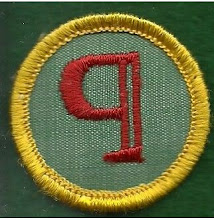
That's the Cadette (Girl Scout) Reporter badge that I earned 'way back when. I’ve wanted to be a writer from my earliest memory; and being a writer meant being a reporter – a journalist. I did and still do love the clatter of typewriters and the AP teletype, the smell and sound of the presses; ink on paper. Reporters can crank out stories fast and to length using the inverted pyramid: use the formula, plug in the info and go. Deadline: you've got ten minutes to write 250 words. Go.

The first writing formula I learned was the inverted pyramid used in news reporting. Who what, when, why, where and how in the first paragraph. Successive paragraphs reiterate what’s in the first paragraph. It’s all about what will fit; we cut stories from the bottom and if only one paragraph fits, the whole story is there. 

The Canal Street Warehouses were destroyed by a four-alarm fire early Tuesday morning. There were no injuries. Fire Marshall Joe Jones reported that the fire started in the fry house of Pete’s Potato Chips and that the cause of the fire is under investigation. Pete “Spud” Peterson, owner of Peterson Foods, was unavailable for comment.

I don’t get to write that Spud Peterson is a roaring drunk; or he only hired illegals; or his kids are in juvie, or his wife… you get the idea. That’s for the op-ed pages, letters to the editor or comments on the web page.

Writing a novel is vastly different. You don’t need to know nuclear astrophysics (just write a NASA astrophysicist into the story), the horses can talk, and people can be purple. You can write anything you want! Whee!

But will I want to read it? You have a better chance of finding readers for your work if you organize your creative writing -- thus, the formula. To be clear, in this blog entry I am looking at formulas that help writers generate a lively arc of action. Many of the manuscripts I read have fabulous characters and a muddled arc of action. I seldom see the opposite -- a great arc of action and boring characters. (More on characters next week.)

FORMULA ONE
What happens when in an arc of action can be broken down in several ways. One way to do this is in Story Engineering by Larry Brooks and is briefly summarized below.

  • How does the story open? Is there an immediate hook?
  • First plot point: the reader is  about a quarter of the way into the story and now the hero’s -journey, his agenda – changes. What happens to bring about that change?
  • Midpoint twist. Brooks calls this “parting the curtain” – for the character, or maybe only for the reader. What do we know now that changes everything?
  • Second plot point: the reader is about three-quarters of the way through the story. The hero should be driving the action—the reader should feel the ending coming up.

FORMULA TWO
I was a scriptwriter (and script editor) before I tackled writing novels, and I still use my old “beat sheet” to hammer out an arc of action. The beat sheet broke down what happens in every minute of a two-hour feature film. All the rising and falling action, all the journeys the characters take, and every revelation can be scripted to the minute. You probably know the beats. For instance, if you are a fan of House, you knew exactly when Hugh Laurie would have the revelation that solved that week's medical mystery.

A great published version of the script beat sheet is Something Startling Happens by Todd Klick. It’s a great read and you can use it to write novels – instead of each script page representing a minute of finished film; say that each minute is one or two or three pages of your manuscript – and there you are, a detailed outline of arc of action. 

Yep, these two formulas are the same thing, stated in different ways; remember that math analogy from last week? Remember: the formula is not there to constrict you;  it’s there so help you organize your information into a brilliant novel. That’s the deal between the reader and the writer; the writer will give the reader what they expect, but the action will speed up or slow down, the lovers don't quite meet, the dog stays lost... for now. 

The writer plays around with the formula.

Tuesday, May 29, 2012

WORD PROBLEM


“Get out a piece of paper and in the upper right/left/center of the page, write your name, date and the word….”

I could get my students to hang on my every syllable with those words. Among the possible responses were:

“…quiz.” (groans)
“…essay question.” (head clutching)
 “…word problem.” (cries for mercy)

Yes, I was a math teacher. I also taught life science, drama, English, world history and journalism. I used the same little script no matter what subject I taught. I used to trip up the script a little; at least three times a semester I’d say,

“…pizza party.” (cheers and applause)

My students would have to plan the pizza party themselves; how to order, where the money would come from; and so forth. One year the enterprising drama students made pizzas in the home ec (oops, “family science”) classroom and sold slices, banked the money and earned enough to buy decent wireless mics for our next production. They didn’t see that as an elaborate word problem, but it was and I seized the moment to show them how they were thinking algebraically. That brought one of my favorite student comments, “Ms Locke, do you have to get algebra into EVERYTHING?”

Well, yes… for instance, this is how math ties in to writing:

If I have two apples and you have three apples, how many apples do we have?

If I have ten apples and you take five apples, how many apples do we have?

 If I have 2.5 apples and you have 2.5 apples, how many apples do we have?

 You have an unknown number of apples. Solve for x.    2x+2=12

Four ways of saying that we have five apples. As a writer, which do you use? As an editor, which one do I think you wanted to use?

He had five apples. (OK, what’s he going to do with them?)

There were only five apples left. (Oooo, why only five apples, weren’t there supposed to be more?)

They each had two-and-a-half apples. (That’s odd, why do they each have half an apple?)

2x+2 =12
2x+2-2 = 12-2
2x=10
2x/2=10/2
x=5
(Why is our heroine doing simple algebra? Ah, I see, “x” represents the apples!)

One of the neat things about math is that (generally), the numbers don’t go off and do whatever they want to do.

Your characters shouldn’t go off and do whatever they want to do either. We, as writers and editors, try to keep the character’s actions consistent within the parameters we’ve created for them. And if you have a character that goes Walter Mitty, you have a darn good reason.

For instance, many of the sample chapters I read for “the Als” (see last week’s blog) would go something like the following.

“You know Sally, there were 23 apples in this dish and now there are just eighteen left, I can’t imagine where the other five apples went. I mean, there are just three of us here, so if two people ate two apples each – I only had one mind you…”

Sally shrugged. “Geez Tom, Dick made an apple pie. It’s sitting on the table.”

I would want to run screaming for my blue pencil to edit that to something like:

Tom looked perplexed. “Weren’t there more apples in this bowl?”

Sally glanced at the bowl and said, “Dick used five of them to make a pie.”

Al taught me that if Tom is a blithering ninny then maybe we want the first version.

Tom can evolve from a blithering ninny to… whatever the author wants him to evolve to; we just don’t want him a ninny in one paragraph and a ultra-confident super spy in the next. Unless of course, Tom is an ultra-confident super spy working undercover; and then I might discover that “apples” is a code word for “diamonds” and “pie” for “heist”.

FORMULAS
The cool thing about math is that formulas have been developed to simplify basic tasks: finding the area of a room or the distance between point A and point C if the distance between point A and point B are known.

And there are formulas for writing. The point, just like in math, is to give us more tools to work with. For instance, tangent can be calculated using a knotted string*, a string and a ruler, using SOHCAHTOA**, punching the numbers into a graphing calculator and hitting the [tan] key, or using an online graphing calculator. You chose the one that works for you, given the materials you have available.

No matter what kind of writer you are -- writing from a neatly-organized outline on your laptop… to stream-of-consciousness, scrawling your words in the sand with a stick -- checking writing against a formula is a great tool.

The first two variables in writing formulas are--

(1)
There’s a protagonist and an antagonist. He author decides who the good guy and who the bad guy is. Perhaps we merely have the lesser of evils (or goodness). Maybe there’s one person all alone on an alien planet – the planet becomes the protagonist or the antagonist.

As mentioned before, these characters have a clear and compelling voice or there is no story.

(2)
Your story is either about everything being OK and going awry; or everything is awry and goes OK. You decide where you put your characters; they can go from burning fires of hell to unicorns and rainbows or anywhere in between.

The rest of the variables in the formula address pacing, flow, and arc of action.

If you’ve read novels written prior to say -- 1900 -- did the pacing, flow or arc of action seem odd to you? Did you expect the action to take one turn when it took another?

How stories flow is something that has evolved between writer and reader and has been deeply influenced by the pacing of movies and television. The reader now expects certain things to happen at certain points in the story. For instance, the reader expects action to build for say… 60 pages… and then they want some resolution to the tension. Maybe the author decides to stretch that out, or compress it or ignore it.

If you play with the formula, then you’re doing it for a reason. You want to jerk your reader’s head around; you do it by not doing what they expect.

Next week: more on the formula.

___________________________________
* A sextant, which assists in measuring the “unknown” leg of a triangle, giving you your position on the planet. For instance -- http://www.mat.uc.pt/~helios/Mestre/Novemb00/H61iflan.htm

**SOHCAHTOA = a way to remember the definition of the basic trigonometry for the sides of a right triangle - the side Opposite the angle, the side Adjacent to the angle, and the long side, the Hypotenuse.

S(ine) = O(pposite)/H(ypotenuse)

C(osine)=A(djacent)/H(ypotenuse)

T(angent)=O(pposite)/A(djacent)

Sunday, May 20, 2012

The "Als"


The “Als” were Albert and Alice; Bert and Lacey to their friends. Professionally they Al Koplinsky, a literary agent specializing in two-fisted detective, police and western novels; and Alice Riesling, literary agent specializing in romance novels and “women’s” fiction. Together they were Zenith Literary Agents.
I was a typesetter at a small community paper and they put a classified ad in looking for an assistant. I typeset in 9 point Century Schoolbook: “Zenith Literary Agents seek assistant. Send resume to Al Koplinsky, 1920 Floral Heights Road…”
I recognized the references to Babbitt, by Sinclair Lewis; it was and still is one of my favorite novels. I reviewed my slim resume and sent it off, with a short cover letter asking if he liked Sinclair Lewis.
Al called me at work a few days later; without preamble he asked what my favorite quote from Babbitt might be.
The question caught me by surprise, “Er, the one where he is defined by the things he owns, there’s a commentary about it in Mark Schor’s afterward in my copy of the book.”
“And what did you think about George Babbitt, young lady?”
“I wanted to like him, or maybe understand him, but he didn't make it easy.”
I heard the sound of a match being struck on the other end of the line. “And what part of the book did you dislike?”
“Where Sinclair Lewis does the obvious comparisons; the dinner parties where people are trying to social climb; one other place where his son is eating ice cream.”
“Very good. Let’s have you come out and meet us.” He gave me driving instructions. I could hear a woman's voice in the background.
“My wife says it's wonderful that you read,” he said and hung up.
They lived in a one of a thousand similar cul-de-sacs in suburbia. I wondered if I'd be able to find it again. Al's office was built over the garage was got up like a 1940’s detective movie—frosted glass door, old oak desk, battered filing cabinets.
“Got all this stuff cheap – they’re tearing it out of the old office buildings in Seattle,” he said. “Sad, but I can have an office like Sam Spade.”
“Or Philip Marlowe,” I said, sitting down in a creaky leather swivel chair. Al gave me an appraising look and lit a cigar.
“How old are you, young lady?”
“Nineteen.”
He scanned my resume. “You want to be a journalist. Why aren’t you reading Tom Wolfe, Kurt Vonnegut, and Hunter S. Thompson?”
“I am, but I like Raymond Chandler’s style.”
Al gave me a typing test, a proofreading test, an editing test. I didn’t know there was a difference between proofreading and editing. Alice tapped on the door and came in. She introduced herself as a “not-quite-retired” teacher.
She “graded” my tests and said, “She’ll do.”
It was a kick working for the “Als”: most of the writers they represented didn’t know that Alice reviewed and answered the query letters and did the first edits on submissions they accepted: two-fisted men’s fiction or flowery romance novels. Al did all the marketing; calling publishers, advertising, arranging for book signings and book tours.
I quickly learned that men wrote romance novels and women wrote westerns. The Als also represented writing teams who could churn out two or three books a year. One team had a science fiction, detective noir, and a chop-socky marital arts manuscript all in production at once.
They put me to work reading through their slush pile. By then end of my first week on the job I could tell I great query letter from a horrid one in two sentences; I could soon do the same with sample chapters. I was disappointed to find that much of what was submitted to the “Als” was dreadful; usually over-written and clichéd. However, bad spelling and punctuation did not mar a great story.
One incredible manuscript was almost unreadable because of spelling errors; the author sent a laboriously handwritten cover letter. He was dyslexic, as father had been; despite that, his father had been a career Army man; a decorated hero in Work War II, the son had gone to Vietnam, served “up to his balls in swamp water” for two years and had come back alive. His story was a fictionalized account of their lives.
Al drove to San Francisco to meet the author. “He’s almost too good to be true,” he said. “But he’s written a great story and I’d take it on even if the author was a poof living in the Castro.”
He called his wife a few evenings later; she took the call in the house and I waited for days for him to come back and enlighten me about what was up. It wasn’t until I was editing the manuscript – my first editing assignment – that I learned that the author was a woman, a friend of the family she’d fictionalized in her novel. They sent my first edit out; she loved it – and then she stopped returning calls.
Al sighed. “Dollars to doughnuts she’s submitted the edited manuscript to a publisher on her own,” he said.
He was right. Al had been shopping the story around; shortly afterward one of the publishers called Al and said, “It was a great first draft, told her to get an agent, polish the manuscript and resubmit.”
As far as I know, the story was never published. Every so often I look for it under one of the three or four titles it could have had. I’ve Googled the author’s name. Nothing.
It was a great story; and my first introduction to the “Al-3”. I still use the three as my primary criteria to meet when reviewing sample chapters, manuscripts and scripts (or working on my own writing). Ideally, the author captures all four in the first two paragraphs of chapter one. Number one on the list is a deal-breaker – if the protagonist doesn’t have a clear and compelling voice, there is no story. Conversely, everything about a submission can be horrible, but if the protagonist has a compelling voice, I’ll keep reading.

1.
Does the protagonist have a clear and compelling voice?

2.
Does the manuscript start “in the action”?

3.
Can I tell right away if the reader is on the outside looking in or the inside looking out?

Sunday, May 13, 2012

I AM MY OWN MINION


I can only think of only one famous and/or rich editor: Jacqueline Kennedy Onassis, who was famous and rich long before she went to work for Viking Press and later, Doubleday. Of course, there is a list: http://www.ranker.com/list/list-of-famous-book-editors/reference (Number fifteen is Jacqueline Kennedy Onassis.)

I'm sure she had assistants. I wish I did, but alas, I am my own minion. I would love to have someone to sort through the slush pile for me the way I did when I worked at the bottom of the minion heap as an editor's second assistant. I read submission letters, sample chapters and manuscripts, prescreening them for the editor's assistant, who would review my recommendations and decide what to present to the editor.
The editor would take on a story from a first-time-author with no agent if the story was compelling, even if the writing was horrendous. He'd speak to the author and see if they understood and could handle substantive editing

For the record:

PROOFREADING is correcting basic errors: typos, spelling, grammar, punctuation, verb tense and subject-verb disagreement, errors in word use, checking copyright issues -- and in the digital age, checking hyperlinks.

COPYEDITING is checking style and consistency, which includes the above, plus: formatting (typestyle, consistent construction for lists, headings, citations, footnotes/endnotes, Bibliography); fact-checking; cross-checking citations, figures, tables with references/source materials; suggesting improvements in syntax for clarity and logical flow. In addition, for fiction: arc of action, dialogue, word choice, POV, sentence structure, clarity.

SUBSTANTIVE EDITING is polishing a manuscript, all of the above, plus: make relatively minor changes; recommend what to delete, rearrange, reword; query author about gaps, contradictions, inconsistencies; polish prose -- suggest clearer phrasing, smoother, better flow of ideas; review copy by multiple authors for consistency.

DEVELOPMENTAL EDITING is working with the author from the idea or early draft stage; this could include ghostwriting or co-authoring a manuscript. Often the proofreading and copy editing is done by another editor.

The publishing house I worked for handled both fiction and non-fiction and I quickly learned that EDITING NON-FICTION is a different than EDITING FICTION. Editors who work with legal, medical and academic papers have a different task -- make the writing clear without changing the meaning of the text.

We might abhor using adverbs in fiction: my English teacher would circle “slowly”, and I would rewrite: “He walked slowly” would become “He dawdled... lingered... dragged his feet... moved slow as a snail on a cold sidewalk...” However, when a doctor writes “slowly” in a professional paper, presumably that's exactly what she means. My edit would be to quantify “slowly” (“5cc/hour?”)

When I started in the business, at least a half-dozen people reviewed a manuscript on the way to publication: an agent, an assistant editor or two, an editor; the typesetter, the proofreader at the type house, and of course, the author, who would review galley proofs.

The agent's job was to smooth the path so the author could write. We had lunch meetings, the editor, the author, the agent, and (eventually) me. I got to know the author. 

But now, an editor or two at the publishing house, perhaps an agent, and the author are responsible for pushing the manuscript to publication. Sometimes it's just the author trying to release an eBook and discovering that it's neither cheap nor easy.

I've never met the authors I work with; we do all our work online. A few years ago one of the authors I worked with was startled to find out that I was a woman; we'd worked on three manuscripts together, all tough-as-nails detective stories. He said, "Your editing voice is very masculine." My response was, "Your protagonist is a man's man, I'm editing as if I were him reading about himself."

Why work as an editor? I edit because I live to write. I've always written and I've always edited, even correcting the grammar and punctuation in my mother's letters to her friends and sisters. I used a red pencil, proudly purchased at the stationery store for just that purpose. I must have been a real pain, but mom would send the letters off with my copy edits in place. Wish I still had those letters; I wonder how well I did editing mom's prose.